

What Two Organelles Are Present In Plant Cells That Are Not Present In Animal Cells?
Learning Outcomes
- Identify key organelles present only in found cells, including chloroplasts and central vacuoles
- Place key organelles present only in animal cells, including centrosomes and lysosomes
At this point, it should be articulate that eukaryotic cells have a more complex structure than practise prokaryotic cells. Organelles allow for diverse functions to occur in the prison cell at the same fourth dimension. Despite their fundamental similarities, in that location are some striking differences between brute and institute cells (come across Figure 1).
Animal cells have centrosomes (or a pair of centrioles), and lysosomes, whereas constitute cells exercise non. Establish cells take a jail cell wall, chloroplasts, plasmodesmata, and plastids used for storage, and a large primal vacuole, whereas fauna cells practice not.
Do Question

Figure 1. (a) A typical animal cell and (b) a typical plant cell.
What structures does a plant cell have that an animate being cell does non have? What structures does an animal cell have that a plant cell does not have?
Show Reply
Found cells accept plasmodesmata, a cell wall, a big central vacuole, chloroplasts, and plastids. Animal cells accept lysosomes and centrosomes.
Plant Cells
The Cell Wall
In Figure 1b, the diagram of a plant prison cell, you see a structure external to the plasma membrane called the prison cell wall. The cell wall is a rigid covering that protects the prison cell, provides structural support, and gives shape to the cell. Fungal cells and some protist cells too have jail cell walls.
While the chief component of prokaryotic cell walls is peptidoglycan, the major organic molecule in the plant prison cell wall is cellulose (Effigy 2), a polysaccharide made up of long, straight chains of glucose units. When nutritional data refers to dietary fiber, information technology is referring to the cellulose content of food.

Figure two. Cellulose is a long chain of β-glucose molecules connected past a 1–iv linkage. The dashed lines at each finish of the figure indicate a series of many more than glucose units. The size of the folio makes it impossible to portray an entire cellulose molecule.
Chloroplasts

Figure 3. This simplified diagram of a chloroplast shows the outer membrane, inner membrane, thylakoids, grana, and stroma.
Like mitochondria, chloroplasts also have their ain DNA and ribosomes. Chloroplasts function in photosynthesis and can be institute in photoautotrophic eukaryotic cells such as plants and algae. In photosynthesis, carbon dioxide, h2o, and light energy are used to make glucose and oxygen. This is the major difference between plants and animals: Plants (autotrophs) are able to brand their own food, similar glucose, whereas animals (heterotrophs) must rely on other organisms for their organic compounds or food source.
Like mitochondria, chloroplasts take outer and inner membranes, just within the infinite enclosed by a chloroplast'due south inner membrane is a set of interconnected and stacked, fluid-filled membrane sacs chosen thylakoids (Figure 3). Each stack of thylakoids is called a granum (plural = grana). The fluid enclosed past the inner membrane and surrounding the grana is called the stroma.
The chloroplasts contain a dark-green pigment called chlorophyll, which captures the energy of sunlight for photosynthesis. Similar plant cells, photosynthetic protists too have chloroplasts. Some bacteria as well perform photosynthesis, but they practise non take chloroplasts. Their photosynthetic pigments are located in the thylakoid membrane inside the cell itself.
Endosymbiosis
We take mentioned that both mitochondria and chloroplasts contain DNA and ribosomes. Accept you wondered why? Strong evidence points to endosymbiosis as the caption.
Symbiosis is a relationship in which organisms from 2 separate species live in shut association and typically exhibit specific adaptations to each other. Endosymbiosis (endo-= within) is a relationship in which ane organism lives inside the other. Endosymbiotic relationships abound in nature. Microbes that produce vitamin Thou live inside the human gut. This relationship is benign for us because we are unable to synthesize vitamin Yard. Information technology is besides beneficial for the microbes because they are protected from other organisms and are provided a stable habitat and abundant food by living within the large intestine.
Scientists take long noticed that bacteria, mitochondria, and chloroplasts are similar in size. We as well know that mitochondria and chloroplasts have Dna and ribosomes, just as bacteria do. Scientists believe that host cells and leaner formed a mutually beneficial endosymbiotic human relationship when the host cells ingested aerobic bacteria and cyanobacteria but did non destroy them. Through development, these ingested bacteria became more specialized in their functions, with the aerobic bacteria condign mitochondria and the photosynthetic bacteria becoming chloroplasts.
Effort It
The Central Vacuole
Previously, we mentioned vacuoles as essential components of plant cells. If you wait at Figure 1b, you will come across that plant cells each accept a large, central vacuole that occupies near of the cell. The fundamental vacuole plays a key role in regulating the cell's concentration of water in changing environmental atmospheric condition. In found cells, the liquid within the key vacuole provides turgor pressure level, which is the outward pressure level caused by the fluid inside the jail cell. Have yous always noticed that if you lot forget to h2o a constitute for a few days, information technology wilts? That is because as the water concentration in the soil becomes lower than the h2o concentration in the found, water moves out of the cardinal vacuoles and cytoplasm and into the soil. As the primal vacuole shrinks, it leaves the prison cell wall unsupported. This loss of support to the prison cell walls of a found results in the wilted appearance. When the cardinal vacuole is filled with water, it provides a low free energy means for the institute cell to expand (as opposed to expending energy to really increase in size). Additionally, this fluid can deter herbivory since the bitter gustation of the wastes information technology contains discourages consumption past insects and animals. The central vacuole also functions to shop proteins in developing seed cells.
Animal Cells
Lysosomes

Figure 4. A macrophage has phagocytized a potentially pathogenic bacterium into a vesicle, which so fuses with a lysosome within the cell so that the pathogen tin be destroyed. Other organelles are nowadays in the jail cell, just for simplicity, are not shown.
In animate being cells, the lysosomes are the cell'due south "garbage disposal." Digestive enzymes inside the lysosomes assist the breakdown of proteins, polysaccharides, lipids, nucleic acids, and even worn-out organelles. In single-celled eukaryotes, lysosomes are of import for digestion of the food they ingest and the recycling of organelles. These enzymes are agile at a much lower pH (more than acidic) than those located in the cytoplasm. Many reactions that take identify in the cytoplasm could not occur at a low pH, thus the advantage of compartmentalizing the eukaryotic prison cell into organelles is credible.
Lysosomes also utilize their hydrolytic enzymes to destroy disease-causing organisms that might enter the cell. A good instance of this occurs in a grouping of white claret cells called macrophages, which are part of your body'south immune system. In a procedure known as phagocytosis, a section of the plasma membrane of the macrophage invaginates (folds in) and engulfs a pathogen. The invaginated section, with the pathogen inside, then pinches itself off from the plasma membrane and becomes a vesicle. The vesicle fuses with a lysosome. The lysosome's hydrolytic enzymes so destroy the pathogen (Effigy 4).
Extracellular Matrix of Creature Cells

Figure five. The extracellular matrix consists of a network of substances secreted by cells.
Most animal cells release materials into the extracellular space. The primary components of these materials are glycoproteins and the protein collagen. Collectively, these materials are chosen the extracellular matrix (Figure 5). Not only does the extracellular matrix hold the cells together to form a tissue, but it also allows the cells inside the tissue to communicate with each other.
Blood clotting provides an case of the part of the extracellular matrix in prison cell communication. When the cells lining a blood vessel are damaged, they display a poly peptide receptor chosen tissue factor. When tissue gene binds with another cistron in the extracellular matrix, it causes platelets to adhere to the wall of the damaged blood vessel, stimulates side by side smooth muscle cells in the blood vessel to contract (thus constricting the blood vessel), and initiates a series of steps that stimulate the platelets to produce clotting factors.
Intercellular Junctions
Cells tin can too communicate with each other by direct contact, referred to every bit intercellular junctions. In that location are some differences in the ways that found and animal cells do this. Plasmodesmata (atypical = plasmodesma) are junctions betwixt plant cells, whereas brute prison cell contacts include tight and gap junctions, and desmosomes.
In general, long stretches of the plasma membranes of neighboring plant cells cannot affect one some other because they are separated past the cell walls surrounding each prison cell. Plasmodesmata are numerous channels that pass between the cell walls of next plant cells, connecting their cytoplasm and enabling signal molecules and nutrients to be transported from cell to cell (Figure 6a).
A tight junction is a watertight seal between two adjacent animal cells (Figure 6b). Proteins agree the cells tightly against each other. This tight adhesion prevents materials from leaking betwixt the cells. Tight junctions are typically found in the epithelial tissue that lines internal organs and cavities, and composes well-nigh of the skin. For example, the tight junctions of the epithelial cells lining the urinary bladder prevent urine from leaking into the extracellular infinite.
Also found just in brute cells are desmosomes, which act similar spot welds between adjacent epithelial cells (Figure 6c). They keep cells together in a canvass-like germination in organs and tissues that stretch, similar the pare, heart, and muscles.
Gap junctions in animal cells are similar plasmodesmata in found cells in that they are channels between adjacent cells that allow for the transport of ions, nutrients, and other substances that enable cells to communicate (Figure 6d). Structurally, however, gap junctions and plasmodesmata differ.
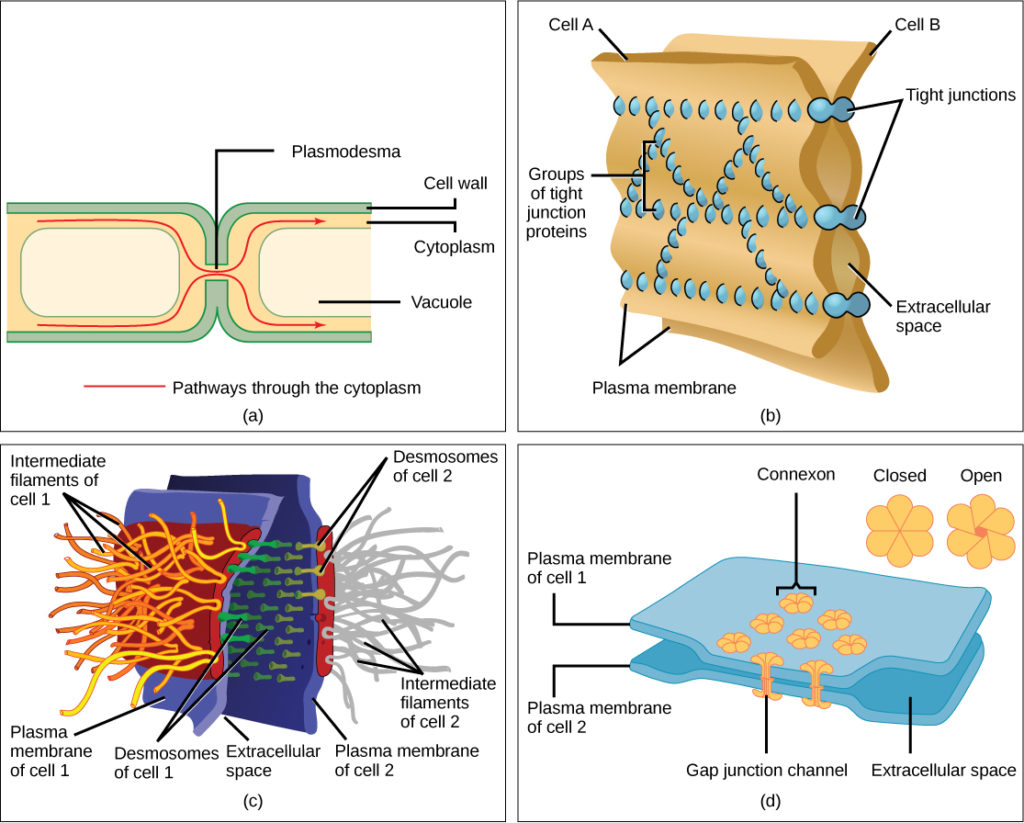
Effigy half-dozen. There are iv kinds of connections betwixt cells. (a) A plasmodesma is a channel betwixt the cell walls of ii next plant cells. (b) Tight junctions bring together adjacent animal cells. (c) Desmosomes bring together 2 animate being cells together. (d) Gap junctions act as channels between animal cells. (credit b, c, d: modification of piece of work by Mariana Ruiz Villareal)
Contribute!
Did you take an thought for improving this content? We'd honey your input.
Improve this pageLearn More than
Source: https://courses.lumenlearning.com/wm-nmbiology1/chapter/animal-cells-versus-plant-cells/
Posted by: bhaktawitheing.blogspot.com
0 Response to "What Two Organelles Are Present In Plant Cells That Are Not Present In Animal Cells?"
Post a Comment