

Are Central Vacuoles Found In Plant And Animal Cells

Plant Prison cell Vacuoles
Vacuoles are membrane-bound sacs inside the cytoplasm of a cell that part in several unlike ways. In mature plant cells, vacuoles tend to be very large and are extremely important in providing structural back up, as well as serving functions such as storage, waste disposal, protection, and growth. Many constitute cells have a large, single central vacuole that typically takes up about of the room in the cell (lxxx percent or more). Vacuoles in animal cells, however, tend to exist much smaller, and are more than ordinarily used to temporarily store materials or to transport substances.
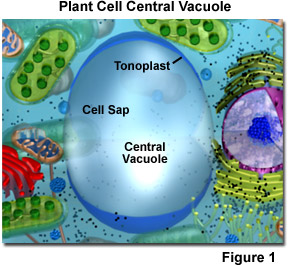
The central vacuole in plant cells (see Effigy ane) is enclosed by a membrane termed the tonoplast, an important and highly integrated component of the plant internal membrane network (endomembrane) organisation. This large vacuole slowly develops every bit the cell matures past fusion of smaller vacuoles derived from the endoplasmic reticulum and Golgi apparatus. Because the primal vacuole is highly selective in transporting materials through its membrane, the chemic palette of the vacuole solution (termed the jail cell sap) differs markedly from that of the surrounding cytoplasm. For case, some vacuoles contain pigments that requite certain flowers their characteristic colors. The central vacuole besides contains constitute wastes that taste bitter to insects and animals, while developing seed cells use the central vacuole as a repository for protein storage.
Among its roles in institute jail cell function, the central vacuole stores salts, minerals, nutrients, proteins, pigments, helps in plant growth, and plays an important structural role for the plant. Under optimal weather, the vacuoles are filled with water to the betoken that they exert a significant pressure confronting the cell wall. This helps maintain the structural integrity of the plant, forth with the support from the jail cell wall, and enables the establish cell to grow much larger without having to synthesize new cytoplasm. In most cases, the plant cytoplasm is bars to a sparse layer positioned between the plasma membrane and the tonoplast, yielding a big ratio of membrane surface to cytoplasm.
The structural importance of the establish vacuole is related to its ability to control turgor pressure. Turgor pressure dictates the rigidity of the jail cell and is associated with the difference between the osmotic pressure inside and outside of the cell. Osmotic pressure is the pressure level required to prevent fluid diffusing through a semipermeable membrane separating two solutions containing unlike concentrations of solute molecules. The response of plant cells to water is a prime example of the significance of turgor pressure. When a constitute receives acceptable amounts of water, the central vacuoles of its cells swell every bit the liquid collects inside them, creating a high level of turgor pressure, which helps maintain the structural integrity of the plant, along with the support from the cell wall. In the absence of enough water, even so, fundamental vacuoles shrink and turgor pressure is reduced, compromising the plant's rigidity so that wilting takes identify.
Plant vacuoles are also important for their office in molecular degradation and storage. Sometimes these functions are carried out by different vacuoles in the aforementioned cell, one serving as a compartment for breaking down materials (similar to the lysosomes institute in animal cells), and another storing nutrients, waste products, or other substances. Several of the materials commonly stored in plant vacuoles have been plant to be useful for humans, such as opium, rubber, and garlic flavoring, and are frequently harvested. Vacuoles also often store the pigments that give certain flowers their colors, which help them in the attraction of bees and other pollinators, merely also tin can release molecules that are poisonous, odoriferous, or unpalatable to various insects and animals, thus discouraging them from consuming the constitute.
Dorsum TO PLANT CELL STRUCTURE
Questions or comments? Send us an electronic mail.
© 1995-2022 past Michael W. Davidson and The Florida State University. All Rights Reserved. No images, graphics, software, scripts, or applets may exist reproduced or used in whatever manner without permission from the copyright holders. Use of this website means you concord to all of the Legal Terms and Weather set forth by the owners.
This website is maintained by our
Graphics & Web Programming Team
in collaboration with Optical Microscopy at the
National High Magnetic Field Laboratory.
Last modification: Friday, Nov 13, 2015 at 02:eighteen PM
Access Count Since October 1, 2000: 1337998
Microscopes provided by:


Source: https://micro.magnet.fsu.edu/cells/plants/vacuole.html
Posted by: bhaktawitheing.blogspot.com
0 Response to "Are Central Vacuoles Found In Plant And Animal Cells"
Post a Comment